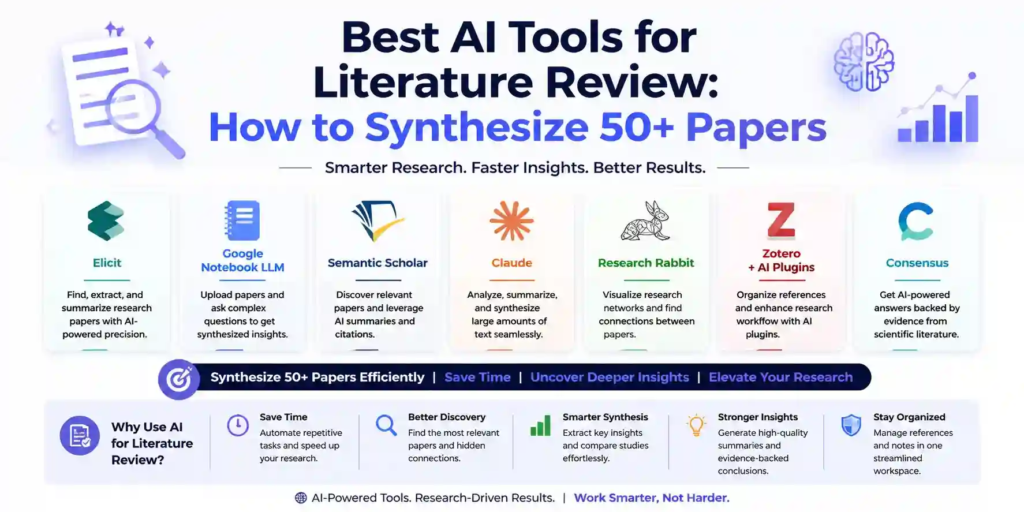
Doing a literature review has always been one of the most time-consuming parts of academic life. You read dozens of papers, try to connect ideas, and somehow turn it into a structured argument. In 2026, things are changing fast thanks to AI tools for academic literature review that help students and researchers work smarter, not harder.
Whether you’re a university student writing your thesis or a PhD researcher managing hundreds of papers, this guide will help you understand the best AI tools available today. We’ll also show you how to actually use them in real workflows.
And yes, platforms like bizmetech.site are also helping students discover these modern academic tools in a simple way.
What is an AI-Powered Literature Review?
Before jumping into tools, let’s quickly clear this up.
A literature review is the process of analyzing existing research on a topic. Traditionally, it involves:
- Reading academic papers
- Highlighting key findings
- Comparing theories
- Writing summaries and connections
Now AI tools can:
- Summarize research papers
- Extract key insights
- Suggest related studies
- Organize citations automatically
- Help build structured review drafts
It doesn’t replace your thinking—it just removes a lot of manual work.
Why Use AI Tools for Academic Literature Review?
Let’s be honest, manual research can feel overwhelming.
Here’s why students are switching to AI tools in 2026:
- Faster paper analysis
- Better organization of research
- Improved understanding of complex studies
- Time-saving citation management
- Reduced reading overload
Instead of spending hours reading a single paper, you can get a structured summary in seconds.
Top AI Tools for Academic Literature Review (2026)
Here are the most effective tools students and researchers are using right now.
1. Elicit AI
Elicit
Elicit is one of the most powerful AI research assistants designed specifically for academic work.
Key features:
- Finds relevant research papers automatically
- Summarizes findings in table format
- Extracts methodologies and results
- Helps compare multiple studies
Best for: Systematic reviews and thesis research
If you’re doing deep academic work, this tool alone can save you days of effort.
2. Scite Assistant
Scite
Scite is unique because it doesn’t just show citations—it shows how a paper is cited.
Key features:
- Smart citation analysis
- Shows supporting vs opposing research
- Helps verify claims
- Improves research credibility
Best for: Validating academic arguments
This is super useful when you want to make sure your sources are actually strong and not misleading.
3. Connected Papers
Connected Papers
Connected Papers helps you visually explore academic research.
Key features:
- Generates research graphs
- Shows related studies visually
- Helps discover hidden connections
- Great for topic exploration
Best for: Understanding research landscapes quickly
Instead of reading random papers, you can actually see how research is connected.
4. Research Rabbit
ResearchRabbit
ResearchRabbit is like Spotify—but for academic papers.
Key features:
- Builds research collections
- Recommends related papers
- Tracks authors and citations
- Visual mapping of research networks
Best for: Long-term research projects and PhD work
It keeps your entire research journey organized in one place.
5. Perplexity AI
Perplexity AI
Perplexity AI is widely used for fast academic searching with citations.
Key features:
- Real-time academic answers
- Cited responses from trusted sources
- Simple explanation of complex topics
- Fast research discovery
Best for: Quick understanding and overview research
It’s like having a research assistant who replies instantly.
Step-by-Step Workflow: Using AI Tools for Literature Review
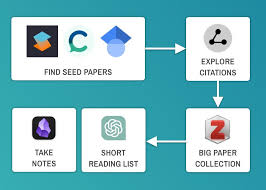
Here’s a simple process students can follow in 2026.
Step 1: Define Your Research Topic
Start clear. For example:
- “Impact of AI in education”
- “Mental health in university students”
A focused topic makes everything easier.
Step 2: Use AI Discovery Tools
Use tools like Elicit AI or Perplexity AI to:
- Find key research papers
- Identify trending themes
- Collect sources quickly
Step 3: Analyze Papers with AI
Upload or input papers into tools like:
- Scite
- Elicit
Then ask:
- “Summarize key findings”
- “What methodology was used?”
- “What are the limitations?”
Step 4: Organize Research Visually
Use Connected Papers or ResearchRabbit to:
- Map relationships between studies
- Group similar research
- Identify gaps in literature
Step 5: Build Your Literature Review Draft
Now combine everything:
- Group themes
- Compare findings
- Highlight contradictions
This is where your critical thinking comes in.
Step 6: Final Editing
AI can help again:
- Check clarity
- Improve structure
- Suggest missing references
But always review it yourself too—don’t skip this step or your work may look generic.
Comparison Table: Best AI Tools for Literature Review
| Tool | Strength | Best Use Case | Learning Curve |
|---|---|---|---|
| Elicit AI | Paper summarization | Thesis & systematic reviews | Medium |
| Scite | Citation analysis | Academic validation | Low |
| Connected Papers | Visual mapping | Topic exploration | Low |
| ResearchRabbit | Research organization | Long-term projects | Medium |
| Perplexity AI | Fast answers | Quick research | Very Low |
Common Mistakes Students Make
Even with AI tools, students sometimes mess up:
- Relying only on summaries without reading full papers
- Mixing unrelated research topics
- Not checking citation accuracy
- Overusing AI without understanding the content
Remember, AI is your assistant, not your replacement.
Pro Tips for Better Literature Reviews
Here are some practical tips that actually help:
- Always cross-check important findings
- Use multiple AI tools together
- Keep notes organized by themes
- Don’t rush the synthesis stage
- Rewrite insights in your own words (this matters a lot)
A small tip many students ignore: if a summary feels too perfect, double-check it manually.
Why This Matters in 2026
In 2026, academic work is becoming more AI-assisted than ever. Universities are not rejecting AI tools—they are encouraging responsible usage.
Knowing how to use AI tools for academic literature review is now a real academic skill, just like referencing or critical analysis.
Websites like bizmetech.site are also helping students stay updated with these tools and understand how to use them properly.