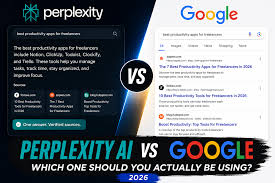
In 2026, students have more ways than ever to find information online. But the real challenge is not access—it’s choosing the right tool.
Two of the most commonly used options are Perplexity AI and Google Search. Both help you find answers, but they work in very different ways.
So the big question is:
👉 Perplexity AI vs Google Search—what should students actually use?
In this guide, we’ll break it down in a simple, student-friendly way so you can decide which tool fits your study needs. Platforms like bizmetech.site are also helping students understand these modern learning tools in a practical way.
What is Perplexity AI?
Perplexity AI is an AI-powered answer engine that gives direct responses instead of just links.
Key Features:
- Provides direct answers with citations
- Summarizes information instantly
- Pulls data from multiple sources
- Works like a conversational search assistant
Instead of showing you 10 links, Perplexity tries to answer your question immediately.
Best for: Quick research, assignments, and concept understanding.
What is Google Search?
Google Search is the world’s most popular search engine. It gives you a list of websites based on your query.
Key Features:
- Massive index of web pages
- Real-time search results
- News, blogs, videos, and academic sources
- Advanced search filters
Unlike AI tools, Google does not directly answer—it shows you where to find answers.
Best for: Deep research, browsing multiple sources, and exploring topics.
Perplexity AI vs Google Search: Quick Comparison Table
| Feature | Perplexity AI | Google Search |
|---|---|---|
| Type | AI Answer Engine | Search Engine |
| Response Style | Direct answers | List of links |
| Speed | Very fast | Fast |
| Source Citations | Built-in | Manual checking |
| Depth of Results | Medium | Very deep |
| Best For | Quick learning | Full research |
1. Speed of Getting Answers
If you are a student doing homework or assignments quickly:
Perplexity AI is usually faster because it gives:
- Direct explanations
- Summarized answers
- Instant citations
Google Search, on the other hand, requires you to:
- Open multiple links
- Read different articles
- Compare information manually
👉 Winner: Perplexity AI
2. Depth of Research
When it comes to deep research, Google still dominates.
With Google Search, you can:
- Access academic journals
- Read full-length articles
- Explore multiple viewpoints
- Find niche resources
Perplexity is good, but it summarizes information, which sometimes limits depth.
👉 Winner: Google Search
3. Accuracy and Trustworthiness
Both tools can be accurate, but they work differently:
- Perplexity provides citations automatically
- Google lets you verify sources yourself
For students, this means:
- Perplexity = faster but needs cross-checking
- Google = slower but more control over sources
👉 Slight edge: Google Search
4. Ease of Use for Students
Perplexity is extremely beginner-friendly:
- Ask a question
- Get a clean answer
- Read summaries instantly
Google requires more effort:
- Click links
- Read pages
- Extract information manually
So for students who want simplicity:
👉 Winner: Perplexity AI
5. Learning and Understanding Topics
If you’re trying to actually understand a topic:
Perplexity helps by:
- Simplifying concepts
- Breaking down explanations
- Giving structured answers
Google helps by:
- Providing multiple perspectives
- Offering deeper resources
Best approach depends on your study style.
👉 Winner: Tie
Step-by-Step Guide: How Students Should Use Both Tools Together
Instead of choosing only one, smart students in 2026 use both.
Step 1: Start with Perplexity AI
Ask:
“Explain photosynthesis in simple terms”
You’ll get:
- A clear explanation
- Key points
- Citations
Step 2: Go Deeper with Google Search
Search:
“Photosynthesis detailed article”
Then:
- Read academic sources
- Compare explanations
- Explore diagrams and videos
Step 3: Cross-Verify Information
Check:
- Do both tools match?
- Are sources reliable?
- Is information consistent?
Step 4: Write Your Assignment
Now combine:
- Perplexity summary
- Google research depth
- Your own understanding
This makes your work stronger and more accurate.
Pros and Cons Summary
Perplexity AI Pros:
- Fast answers
- Simple explanations
- Built-in citations
- Great for quick learning
Perplexity AI Cons:
- Limited deep exploration
- Sometimes oversimplifies topics
Google Search Pros:
- Massive information base
- Deep research capability
- Multiple perspectives
- Best for academic work
Google Search Cons:
- Takes more time
- Requires manual filtering
- Can be overwhelming for beginners
Common Mistakes Students Make
Even with both tools available, students often:
- Rely only on AI summaries
- Don’t verify sources properly
- Skip reading full articles
- Copy answers without understanding
And honestly, sometimes students rush the proccess and end up with incomplete research.
Which One Should Students Use in 2026?
Here’s the simple answer:
- If you want quick answers and summaries → use Perplexity AI
- If you want deep research and full sources → use Google Search
- If you want the best results → use both together
There is no single winner—it depends on your academic need.
Why This Comparison Matters in 2026
In 2026, students are not just searching anymore—they are learning with AI assistance.
Understanding Perplexity AI vs Google Search helps students:
- Improve research efficiency
- Save time on assignments
- Access better information
- Learn smarter, not harder
Platforms like bizmetech.site are also helping students stay updated with these tools and learn how to use them effectively in real academic life.
Final Thoughts
Both Perplexity AI and Google Search are powerful in their own way.
Perplexity is like a fast tutor that explains things instantly.
Google is like a huge library where you can explore everything in detail.
Smart students don’t choose one—they use both depending on the situation.
And once you learn how to balance them properly, your research and assignments become much easier, faster, and honestly less stressful too.