If you’ve ever spent hours re-reading notes only to forget everything the next day… yeah, your not alone.
In 2026, students are finally moving away from passive study methods and shifting toward AI-powered active recall techniques. One of the most powerful tools leading this shift is Anki — now supercharged with AI.
On bizmetech.site, we focus on helping students study smarter, not harder. And honestly, once you understand how AI + flashcards + active recall works together, it can completely change how you learn.
Let’s break it down in a simple, student-friendly way.
What is Active Recall (and why it actually works)?
Active recall is a learning technique where you force your brain to retrieve information instead of just reviewing it.
Instead of:
- Reading notes again and again ❌
You do:
- Ask yourself questions
- Try to remember answers
- Check if you’re right ✅
This process strengthens memory like a muscle.
Now combine that with spaced repetition (reviewing at increasing intervals), and you’ve got one of the most effective study systems ever created.
That’s exactly what Anki does… but AI makes it even better.
What is Anki AI in 2026?
Traditional Anki was already powerful. But now, with AI integration, it has evolved into something much smarter.
Anki AI helps you:
- Automatically generate flashcards from notes, PDFs, or lectures
- Improve poorly written cards
- Predict what you’re likely to forget
- Optimize review schedules dynamically
Think of it like having a personal study assistant that knows your weak points better than you do.
And yes… it saves a LOT of time.
How AI Improves Flashcards (Big Upgrade 🚀)
Here’s where things get interesting.
Before AI:
- You had to manually create every flashcard
- Poor wording = poor learning
- Took hours to set up
Now with AI:
- Paste notes → instant flashcards
- AI rewrites them into clear, exam-focused questions
- It avoids overly long or useless cards
Example:
Your notes:
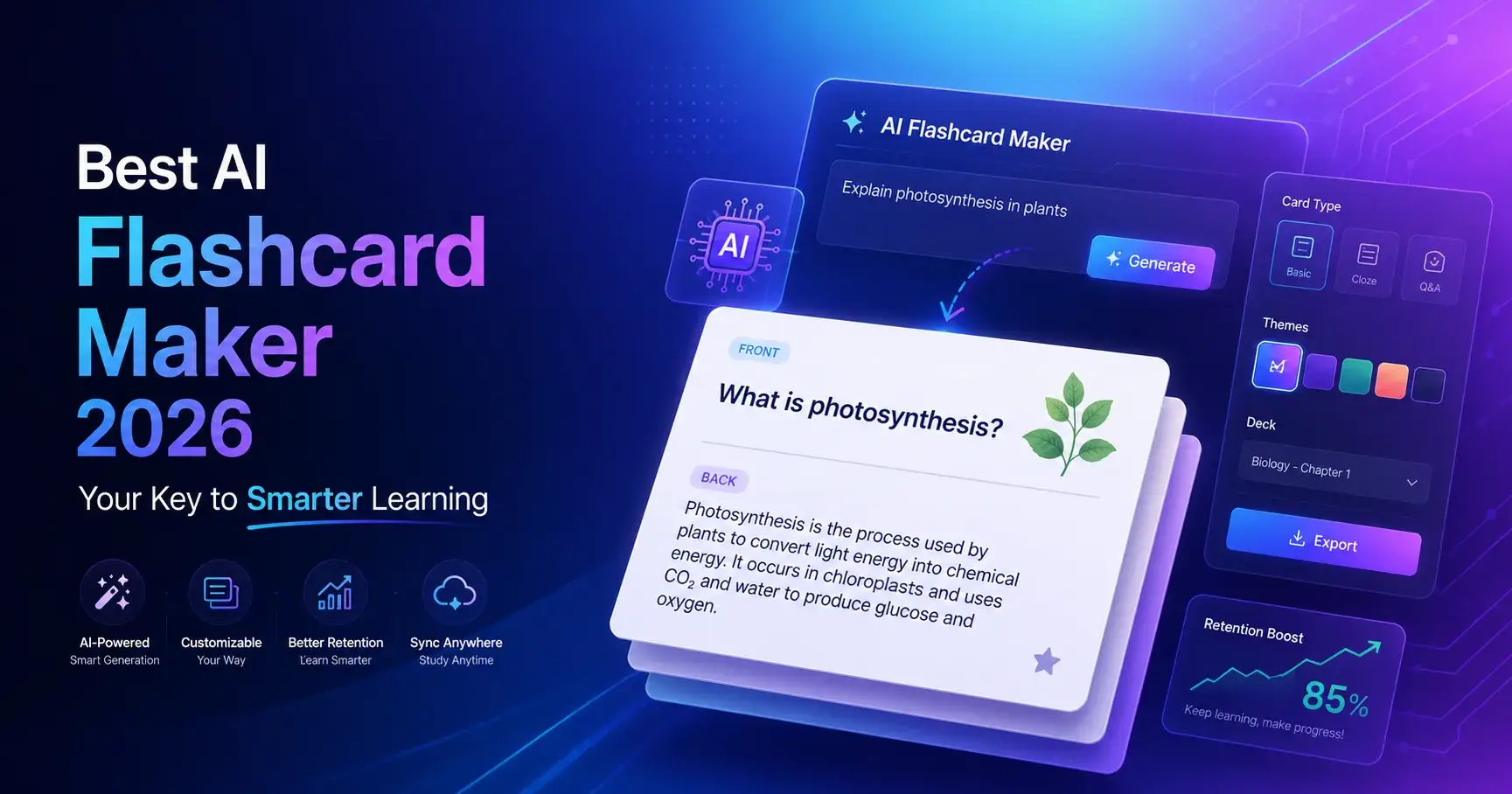
Photosynthesis occurs in chloroplasts and uses sunlight to convert CO₂ into glucose.
AI flashcards:
- Where does photosynthesis occur?
- What is the main function of photosynthesis?
- What inputs are required for photosynthesis?
See the difference? Much easier to recall.
Step-by-Step Guide: Using AI for Flashcards in Anki
Here’s a simple proccess you can follow:
Step 1: Gather Your Study Material
- Lecture notes
- PDFs
- Textbooks
- Slides
Step 2: Use an AI Tool
Use tools like:
- ChatGPT
- Anki AI plugins
- Note-to-flashcard converters
Paste your content and ask:
“Convert this into active recall flashcards.”
Step 3: Import into Anki
- Copy generated flashcards
- Paste into Anki
- Organize into decks
Step 4: Let Spaced Repetition Work
Anki will:
- Show cards just before you forget
- Increase intervals over time
- Focus on weak areas
Step 5: Review Daily (Important!)
Consistency matters more than intensity.
Even 20–30 minutes daily > 5 hours once a week.
Comparison Table: Traditional vs AI Flashcards
| Feature | Traditional Flashcards | AI-Powered Flashcards |
|---|---|---|
| Creation Time | Slow | Very fast |
| Quality | Depends on student | Optimized by AI |
| Personalization | Low | High |
| Error Detection | Manual | Automatic |
| Efficiency | Medium | Very high |
Honestly, once you switch to AI, going back feels… painful 😅
Best Practices for AI Flashcards (Don’t Skip This)
AI is powerful, but you still need to use it correctly.
Keep Cards Simple
One question = one idea.
Bad:
Explain everything about photosynthesis.
Good:
What is the function of chlorophyll?
Use Your Own Understanding
Don’t blindly trust AI.
Always:
- Review generated cards
- Edit if needed
- Add personal examples
Avoid Overloading
Too many cards = burnout.
Focus on:
- High-yield topics
- Exam-relevant info
Mix Question Types
Use:
- Definitions
- Concepts
- Application questions
This improves deeper learning.
Common Mistakes Students Make
Let’s be real… a lot of students misuse Anki.
Mistake 1: Copy-Paste Without Thinking
AI gives you cards, but your brain needs engagement.
Mistake 2: Skipping Reviews
Spaced repetition only works if you actually show up.
Mistake 3: Making Cards Too Long
Long cards = slow reviews = frustration.
Mistake 4: Over-relying on AI
AI helps, but it’s not magic.
You still need to understand the material.
Why This Matters in 2026
Education is changing fast.
Students who:
- Use AI tools
- Apply active recall
- Study efficiently
Will outperform those who just rely on traditional methods.
At bizmetech.site, we’ve seen a clear trend:
👉 Students using AI-powered study systems retain more in less time
👉 They feel less stressed before exams
👉 And they actually enjoy studying more (yes, really)
Final Thoughts
If your still studying by re-reading notes… it’s time to upgrade.
Using AI + Anki + active recall is one of the smartest moves you can make in 2026.
It’s not about studying harder anymore.
It’s about studying smarter.
Start small:
- Try converting one chapter into flashcards
- Review daily
- Adjust your system
In a few weeks, you’ll notice a huge difference.
And once it clicks… you won’t go back.