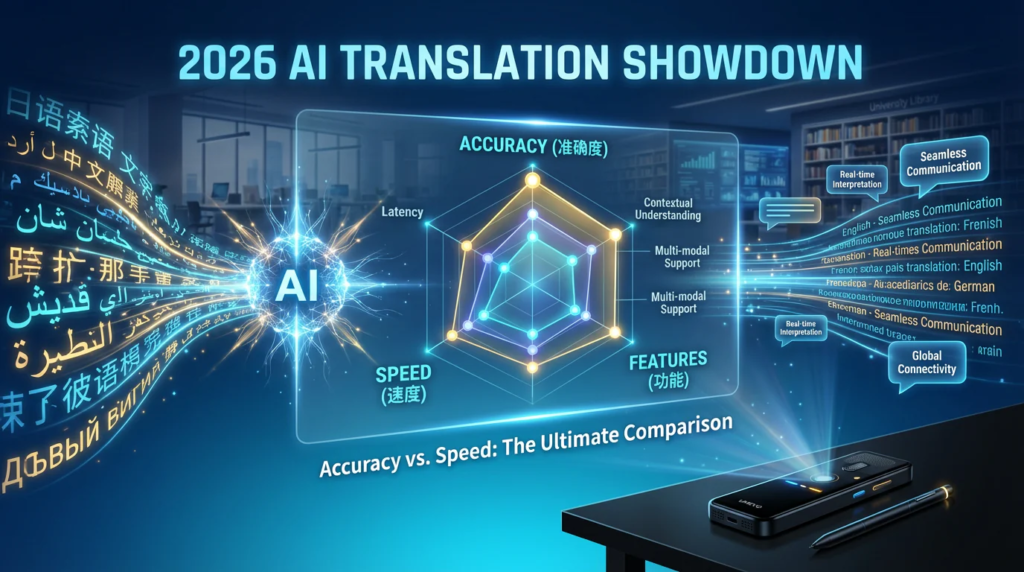
Discover the best free AI tools to translate research papers accurately in 2026. Save time, boost comprehension, and break language barriers effortlessly.
If your a student or researcher trying to make sense of a paper written in German, Chinese, or Arabic — you already know the struggle. Academic language is dense enough on its own. Add a foreign language to the mix, and suddenly even finding the methodology section feels like a mission. The good news? In 2026, free AI translation tools have gotten remarkably good — especially for scientific and academic content.
At bizmetech.site, we’ve been tracking the evolution of AI-powered tools for students and researchers, and this year’s lineup is genuinely impressive. Let’s break down the best free options, how they work, and which one is right for your workflow.
Why Standard Translation Tools Fall Short for Research Papers
Google Translate used to be the go-to. And honestly? For casual use, it still works fine. But research papers are a different beast. They’re packed with domain-specific terminology, complex sentence structures, and citations that regular translators often butcher completely.
A biology paper might use a term that has one meaning in everyday language and a completely different meaning in molecular biology. A standard NLP model trained on web text won’t always catch that nuance. That’s why AI tools specifically optimized for academic and scientific content have become so valuable.
Top Free AI Tools to Translate Research Papers in 2026
1. DeepL (Free Tier)
DeepL has become the gold standard for nuanced translation. It uses a neural machine translation (NMT) engine that understands context far better than phrase-based models. The free version allows document uploads (up to 3 per month on the free plan) and handles PDF research papers surprisingly well.
Best for: European languages (German, French, Spanish, Dutch) Limitation: Less accurate for Asian and Middle Eastern languages
2. ChatGPT (Free Version via OpenAI)
Don’t sleep on this one. You can paste sections of a research paper directly into ChatGPT and ask it to translate while preserving technical terminology. What makes it unique is that you can prompt it to explain what it’s translating — so it’s educational, not just functional.
Try prompting: “Translate this abstract from Mandarin to English. Preserve all scientific terms and explain any phrases that don’t have a direct English equivalent.”
Best for: Getting translated content with explanations Limitation: Context window means you may need to chunk longer papers
3. Google Translate (with Lens + Scholar Mode)
Okay, hear us out. Google Translate in 2026 isn’t your 2015 Google Translate. The Google Lens integration lets you point your phone at a printed paper and get a real-time translation overlay. More importantly, it now has improved academic context models for scientific content.
For a free, zero-friction solution — especially for quick passes — it’s still very much in the conversation.
Best for: Quick translation of specific paragraphs or figures Limitation: Still struggles with highly specialized terminology
4. SciSpace (formerly Typeset)
This one’s built specifically for research papers. SciSpace lets you upload a PDF and uses AI to translate and summarize the content simultaneously. It’s not just translation — it’s comprehension assistance. You can even ask follow-up questions about the paper in your language.
Best for: Full-paper translation with Q&A functionality Limitation: Some advanced features are behind a paywall
5. Papago by Naver
If you’re working with Korean, Japanese, or Chinese academic content, Papago deserves a serious look. Developed by Naver (a Korean tech giant), it was trained on a massive corpus of East Asian text, including academic content. The accuracy for those language pairs genuinely rivals DeepL.
Best for: East Asian language pairs Limitation: Weaker performance outside of Asian languages
Comparison Table: Free AI Translation Tools for Research Papers
| Tool | Best Language Pairs | PDF Upload | Academic Accuracy | Free Tier Limits |
|---|---|---|---|---|
| DeepL | European languages | ✅ Yes | ⭐⭐⭐⭐⭐ | 3 docs/month |
| ChatGPT | All major languages | ❌ (paste text) | ⭐⭐⭐⭐ | Limited context window |
| Google Translate | 130+ languages | ✅ Yes | ⭐⭐⭐ | Unlimited |
| SciSpace | Major languages | ✅ Yes | ⭐⭐⭐⭐⭐ | Limited Q&A queries |
| Papago | Asian languages | ✅ Yes | ⭐⭐⭐⭐ | Unlimited |
Step-by-Step Guide: How to Translate a Research Paper Using SciSpace (Free)
Here’s a simple walkthrough to get you started with one of the best tools available:
Step 1: Go to SciSpace Visit typeset.io and create a free account. Takes about 60 seconds.
Step 2: Upload Your PDF Click “Upload Paper” and drag in your research paper. SciSpace supports most PDF formats, including scanned documents with OCR processing.
Step 3: Select Translation Language Once the paper loads, look for the language selector in the top panel. Choose your target language — English, Hindi, Arabic, Spanish, and several others are supported.
Step 4: Read the Translated Summary SciSpace will first give you a translated abstract and summary. This is great for quickly deciding whether a paper is worth reading in full.
Step 5: Ask Follow-Up Questions Use the AI chat panel to ask things like “What methodology did the authors use?” or “What are the main conclusions?” — all in your native language. This is where SciSpace genuinely stands out from basic translation tools.
Step 6: Export or Copy Copy translated sections directly, or export the summary as a text file for your notes.
Pro Tips for Getting Accurate Translations
- Always cross-check key terms using a subject-specific glossary or Wikipedia in your target language.
- When using ChatGPT, specify the field (e.g., “this is a neuroscience paper”) so the model applies the right domain context.
- For papers with lots of equations and figures, SciSpace or DeepL tend to handle layout better than copy-paste tools.
- If your translating a paper that’s been scanned (not digitally created), make sure the tool supports OCR — not all of them do.
Final Thoughts
The proccess of translating academic research used to be expensive, slow, or just inaccurate. In 2026, that’s genuinely no longer the case — especially with the free-tier offerings from tools like SciSpace, DeepL, and even ChatGPT.
Whether you’re a grad student hunting down sources in a foreign language or a researcher trying to collaborate across language barriers, these tools can seriously transform your workflow. For more roundups like this one, check out bizmetech.site — it’s where we break down the tech that actually matters for students and professionals.
Start with SciSpace if you want the full academic experience. Start with DeepL if you just need clean, accurate translation fast. Either way, you’ve got no excuse not to explore that paper sitting in your downloads folder.